


The Future of Cardiac Care: Sutureless Heart Surgery vs. Traditional Open Heart Surgery
What is Traditional Open Heart Surgery?
In a traditional aortic valve replacement (AVR), the cardiac surgeon makes an incision down the chest, carefully separates the breastbone to access the heart, and connects the patient to a heart-lung bypass machine. Once the damaged natural valve is removed, the surgeon must meticulously hand-sew the new artificial valve into place using tiny stitches called sutures. A standard valve replacement typically requires 12 to 18 individual sutures, a precise process that takes significant time while the heart is stopped.
What is Sutureless Heart Surgery?
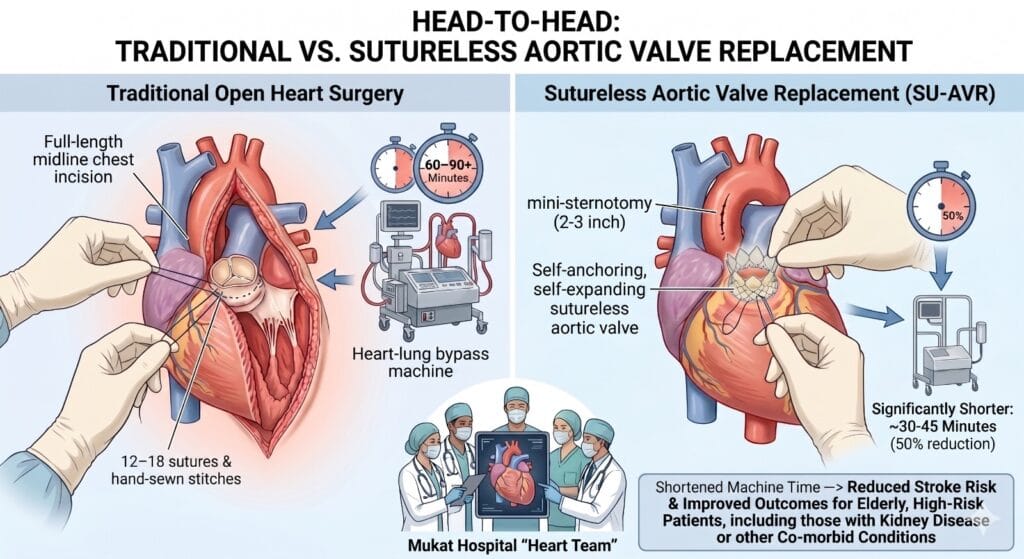
Sutureless heart surgery utilizes a highly advanced, self-expanding or anchoring artificial valve. Instead of manually stitching the new valve into place, the surgeon removes the diseased valve and positions the new sutureless valve inside the heart. Once deployed, the valve expands and anchors itself securely against the tissue under natural pressure. The surgeon may use just one or two securing stitches for absolute stability, but the process completely eliminates the need for dozens of time-consuming hand-sewn knots.
Head-to-Head: How They Compare
Feature |
Traditional Open Heart Surgery |
Sutureless Heart Surgery |
|---|---|---|
Fixation Method
|
12–18 hand-sewn stitches (sutures)
|
Self-anchoring, expanding framework
|
Time on Bypass Machine
|
Longer (typically 60–90+ minutes)
|
Significantly shorter (often reduced by less time, 50%)
|
Incision Options
|
Requires a full midline chest incision
|
Can be done via a tiny, minimally invasive incision (mini-sternotomy)
|
Recovery Time
|
6 to 8 weeks for complete healing
|
2 to 4 weeks with less post-op discomfort
|
Ideal For
|
Standard patients with no complex anatomy, younger age group
|
High-risk, elderly, or multi-procedure patients
|
The Big Win: Why "Less Time on the Machine" Matters
The single greatest advantage of sutureless heart surgery comes down to a clock. During a valve replacement, the patient relies on a heart-lung bypass machine while the heart is temporarily stopped (called cross-clamp time). Because a sutureless valve can be anchored in just a few minutes rather than hand-stitched over half an hour, the overall time the patient spends on the bypass machine is significantly less. For elderly patients, or those with other health conditions like kidney disease (creatinine) or any other co-morbid condition, minimizing bypass time drastically reduces the risk of post-operative complications, stroke, and inflammation, and other complications.
Key Benefits of the Sutureless Approach:
- Minimally Invasive: Because the valve is easier to position, surgeons can often place it through a tiny 2-to-3 inch incision between the ribs, leaving the breastbone completely intact.
- Rapid Recovery: Less time in the operating room means less time in the ICU, fewer days in the hospital, and a much quicker return to daily life in Chandigarh.
- Excellent Fluid Dynamics: Sutureless valves do not have a bulky sewing ring, allowing for better blood flow through the newly installed valve.
Which Option is Right for You?
While sutureless surgery sounds like the obvious choice, it is not a one-size-fits-all solution. Traditional open-heart surgery remains vital for patients with highly complex heart anatomy or those needing multiple complex repairs at once. At Mukat Hospital, our multidisciplinary “Heart Team” evaluates every patient individually. Factors such as age, overall physical fitness, anatomical variations, including different valve anatomies, help us determine which pathway offers the safest, most successful outcome.
Considering Cardiac Care?
If you or a loved one have been advised to undergo valve surgery, get an expert opinion from the leading cardiac specialists in the Tricity. Sutureless vs Open Heart Surgery
- Location: Mukat Hospital, Sector 34-A, Chandigarh.
- 24/7 Emergency & Consultations: +91 90238-84444


